Naked Spartans and Sex in Saunas
Throughout history and across the world, the pattern is remarkably consistent. When women are in the majority and there aren’t enough men to go around, dating culture shifts toward a more sexually unrestricted mode—what I call Hookup Mode. Both men and women have more sexual partners. Romantic relationships are less close, less loving, and less committed. Think fewer dates at fancy restaurants, more 2:00 a.m. eggplant emojis.
People become more obsessed with physical attractiveness, body shape, and facial symmetry. Marriage rates decrease; rates of teen pregnancy increase. More first dates begin with weasly disclaimers like, “Just a heads up, I’m not really looking for a relationship right now.”
When men are in short supply, in other words, it throws the entire culture into a promiscuous dating mode in which people pursue (or at the very least tolerate) short-term sex hookups at the expense of long-term committed relationships. This shift is what I call Hookup Mode Bias—when we inadvertently switch to a more sexually unrestricted, less relationship-oriented approach to dating without consciously deciding to do so.
When it’s women who are scarce, on the other hand, the dynamic is reversed. When there aren’t enough women to go around, the entire culture becomes more monogamous and more relationship-oriented—what I call Relationship Mode. People go on more dates and get to know each other better before they have sex. Men invest more energy, emotion, and money into wooing and courtship.
In places where men outnumber women, studies show, people have fewer sexual partners. More people get married, and at younger ages. Divorce rates plummet. People are less comfortable with the idea of casual sex. Men spend more money on displays of love and commitment, own more credit cards, and invest more energy in long-term relationships. Sales of diamond necklaces engraved with “You complete me” go through the roof, probably.
When women are in short supply, in other words, the entire culture inclines toward Relationship Mode.
Why does it work out this way? Although it’s 100 percent icky and unromantic to imagine that this is how love works, research suggests the rules of the game are governed by the laws of supply and demand. As we know from economics, when the supply of a commodity goes down, its price goes up. The same principle, it turns out, applies to dating dynamics. The gender that’s scarce becomes more valuable—which means they’re the ones who make the rules for dating and sex.
“It’s kind of a gender dynamics marketplace idea,” explains David Schmitt, a personality psychologist at Brunel University London. “When women are rare, they’re the ones who are ‘more valuable consumers,’ and the society has to shift toward their preferred sexuality—which is more restricted. When men are rare, they’re the more valued consumers. They’re tough to get, so the system has to satisfy their desires.”
This doesn’t imply that all men are louts who just want to sleep around and all women are connivers who just want to tie men down. Everyone is different, what we want is context-dependent, and studies show that men want just as much as women to get married and have a committed life partner. It just means that on average, all things being equal, men are more inclined toward short-term mating—which means that’s the direction things go when men are the hot commodity.
When there aren’t enough men to go around, women have to play by men’s rules. Men don’t commit as much because they don’t have to. Everyone has more casual sex. The entire culture veers into Hookup Mode.
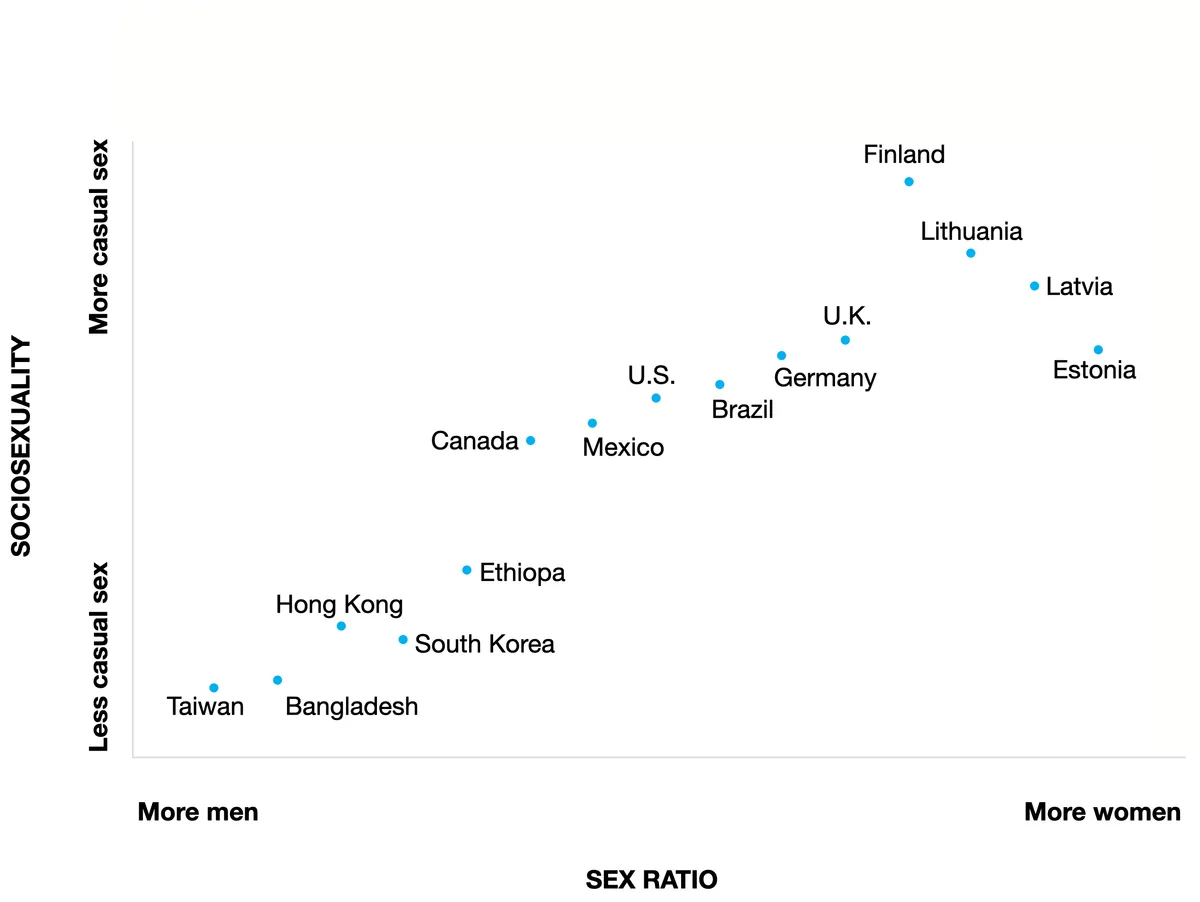
The pattern holds true in cultures around the world. In countries with more men than women, like South Korea and Bangladesh, the dating culture is more traditional and more sexually conservative. In countries with more women than men, the sexual culture is more open and permissive, and premarital sex is seen as normal.
In China, for instance, where decades of one-child policy and a cultural preference for male children have given rise to a desperate shortage of women, dating is often still a direct path to marriage, and sex is seen as a serious thing. Especially outside of modern, cosmopolitan cities like Shanghai and Beijing, premarital sex is still taboo, and many men still expect to marry virgins.
In Finland, by contrast, where women are in the majority, marriage is increasingly seen as adorably old-fashioned, and casual sex is a routine recreational pastime as ordinary and free of moral judgment as taking a steam sauna or eating pickled herring for breakfast.
In fact, the correlation between female-majority sex ratios and sexual permissiveness stretches back through antiquity. In ancient Athens, where women were in short supply due to female infanticide and rampant neglect of daughters, female sexuality was highly constrained. Men believed a woman’s sole purpose in society was to bear and raise children, and respectable women pretty much couldn’t leave their houses. Women married young, brides had to be virgins, and seduction and adultery were crimes so heinous that transgressors could be punished by being sold into slavery. And I thought my parents were strict.
Sparta, meanwhile—a fierce military city-state where young men left early to train as warriors and often died in battle—was much more sex-positive. With not enough men to go around, women exercised naked, married only after they were old enough to “enjoy sex,” and had a reputation for promiscuity and mate swapping.
In Sparta, girls wrestled, threw javelins, and studied poetry just like boys, and adultery was punished with a fine. Perhaps not coincidentally, Sparta was also home to Greek mythology’s most famous adulteress, Helen of Troy.
The most comprehensive evidence for the idea that female-majority sex ratios trigger Hookup Mode comes from The International Sexuality Description Project, a massive cross-cultural study on sex and personality, led by David Schmitt, in which 100 social, behavioral, and biological scientists administered surveys to more than 50,000 people from 56 different countries across six continents in 30 languages.
Published in Behavioral and Brain Sciences under the title “Sociosexuality from Argentina to Zimbabwe: A 48-nation study of sex, culture, and strategies,” the study compared each country’s sex ratio (among adults of reproductive age) to its citizens’ level of “sociosexuality”—a concept akin to promiscuity that specifically refers to people’s desire and willingness to have sex outside of a committed relationship.
As predicted, the data showed that countries with fewer men than women have higher levels of sociosexuality. In other words, their dating cultures are defined by more promiscuity and casual sex.
In countries like Estonia, Latvia, and Lithuania, for instance, where high rates of suicide and accidents among men have yielded a surplus of women, sociosexuality rates are high. In countries with an abundance of men, like Hong Kong, Bangladesh, and Taiwan, sociosexuality scores are low: People are less willing to engage in uncommitted sexual relationships. Monogamy reigns.
The pattern holds true within the United States as well, as shown, for instance, in studies like this one, whose title pretty much says it all: “Scarcity of Female Mates Predicts Regional Variation in Men’s and Women’s Sociosexual Orientation Across US States.”
In cities like Denver (which is so male-dominated they call it “Menver”) and San Jose (a.k.a. “Man Jose”), the dating culture tends more toward long-term relationships. People get married young and hookup culture is not as prevalent. In cities like Miami and New York City, on the other hand, women are in the majority. Among New Yorkers under 35 with college degrees, there are 100,000 more women than men. It’s no coincidence that these man-deprived cities are known for short-term relationships and casual sex.
In a lot of cities, the sex ratio among straight people is even more female-majority than it seems from the stats, since the number of gay men exceeds the number of lesbians. In Manhattan, among hetero college grads under 30, the dating pool has only two men for every three women. That’s at least partly why New York City is the epicenter of live-for-tonight, hedonistic sexual culture—and why Sex and the City was set in New York, and not say, San Francisco.
Bibles and Boob Jobs
For a vivid illustration of how powerfully an imbalanced sex ratio can affect a dating pool, consider the obsession with plastic surgery that’s currently raging within the Mormon Church in Utah.
The cultural fissure behind this curious phenomenon is that men leave the Mormon church at much higher rates than women do, creating an intensely lopsided sex ratio. (The joke in Utah is that atheist meetups are a great place to meet single men.) The steady exodus of men leads to an extreme shortage of men in the dating pool. Among Utah Mormons, there are 50 percent fewer men than women. That’s two men for every three women.
Without fail, a gender imbalance this acute is destined to unleash Hookup Mode. But what does Hookup Mode look like in a religion that prohibits hookups, alcohol, and premarital sex altogether—and compels its devotees to marry young?
With no way to explore short-term mating without risking excommunication, a culture has arisen, Jon Birger explains, in which men have all the power and women are viewed as sex objects. (As in, even more so than usual.)
“Mormon men have become much more demanding about women’s looks,” Birger writes, “which in turn has made women obsessed with standing out from the competition.” In fact, Birger argues, the sex ratio is so lopsided that it’s sparked a “cosmetic arms race:” a frenzy of liposuction, Botox, and breast augmentation surgery so pervasive as to rival even the most desperate housewives. According to a RealSelf study, Google searches for breast implants in Salt Lake City are the highest in the country—and Forbes named it “America’s Vainest City.”
“I have seen more outrageous boob jobs and facial plastic surgery in Utah than almost anywhere in the country—especially among Mormon women,” says one Mormon woman quoted in Birger’s book. “They may claim chastity as a virtue overall, but that’s not stopping anyone from getting a set of double Ds.”
Chivalry Is Dead
Perhaps the best illustration of the power of male-majority sex ratios to influence dating behavior comes from a system of courtship rules that emerged in the Middle Ages: chivalry and courtly love.
When we hear the word “chivalry,” we usually think of gracious, gentlemanly gestures on the part of men. When a man offers his subway seat to a woman, gives her his jacket when she’s cold, or walks around to the far side of the Uber to open the car door for her, he’s being chivalrous.
What fewer people know is that the rules and ideals of chivalry originally arose due to a scarcity of women among the nobility of Europe in the Middle Ages, as Marcia Guttentag and Paul F. Secord explain in Too Many Women? The Sex Ratio Question, the classic book that launched the study of sex ratio in dating.
The word “chivalry” comes from the Old French chevalier, meaning horseman or knight. In medieval Europe, knights were basically professional soldiers—heavily armored warriors on horseback who worked as mercenaries or bodyguards for a lord.
Compared to the grim plight of peasant farmers, who literally had to pay landowners for the right to cultivate the land, knighthood was a highly lucrative gig. In return for their service to the nobles, knights were rewarded with land of their own.
A knight’s main job was to defend the lord’s castle against rampaging marauders and to ride horses into battle, armed with a lance and a sword. (And then presumably gallop back home over the drawbridge to spray down his suit of armor with WD-40, slip into his baby dragon onesie, and sip mead while gazing out over the moat at all the dirty plebes below? I’m not too sure, I’m more of a romcom person myself.)
Traditionally, knights were of noble birth. At the time, under the feudal system of Medieval Europe, people were pretty much born into their role in society. Monarch or peasant, there wasn’t much you could do to change your position in the rigid social hierarchy. For most people, “born a serf, die a serf” was the extent of their vision board.
But from the 11th to 13th centuries, all that began to change. A population boom in Europe and a unprecedented frenzy of castle-building created job openings for thousands of new knights. It was an all-out medieval hiring spree, but with jousting tournaments and sword fights standing in for résumés and LinkedIn profiles.
Suddenly, class lines liquefied. For men of non-noble origins, knighthood became a tantalizing new path to nobility. By putting himself in service of a castle, a lowborn man—the son of a peasant or serf—could now rise up into the military class, receiving land of his own and enjoying the privileges of nobility.
But to cement his newfound social status and make sure his children would be born into the noble class, there was one thing the newly knighted man needed to do: marry a noblewoman.
And therein lay the problem. The imperative among new knights to marry a woman of noble birth created a novel social context in which thousands of upwardly mobile men were now forced to compete for a small number of noblewomen. In other words: a mating market with a male-majority sex ratio.
To become noblemen, these newly minted knights—men who’d begun their careers as hired thugs—had to act the part, refining their manners and taking care to speak and act with dignity and honor.
That’s where chivalry came in. Chivalry was a gentlemanly code of conduct defined by bravery, devotion, and most of all, duty and service to a lady. For a lowborn man to win the affections of a noblewoman, he had to prove himself worthy of her. Often, that meant subjecting himself to ordeals and performing deeds of heroism in her name in hopes of impressing her with his bravery and commitment.
In pursuit of nobility, it became customary for knights to devote themselves to courtly love—the worship of beautiful but unattainable women, even those who were already married. For ambitious young knights, the ritualized public adoration of women became a national pastime.
Best case scenario, the knight’s displays of courtly love would sweep the noblewoman off her feet and they would marry. But even if he didn’t get the girl, people believed, the knight’s love and devotion itself would exalt him from his lowly origins. Even unrequited, love was inherently ennobling.
Today, when people say “chivalry is dead,” what they mean is that men no longer act this way. These days, some men won’t even hold a door open for a woman, let alone throw a coat over a puddle for her. As my female friends will tell you, men today are far more likely to text at midnight asking “u up?” than they are to take a woman out to dinner.
“Men today just aren’t willing to try hard,” one female friend told me. “My experience of dating is that there isn’t much courting that goes on. Men are like, ‘Meh, I’ll just find another woman online.’”
Times have changed since the days of knights and maidens, castles and dungeons. These days, if a man tries too hard to be chivalrous—say, by bringing her flowers on a first date—she probably assumes he’s a desperate loser, if not a serial killer.
Spoiler alert: Modern dating is pretty different from the days when knights devoted their lives to dazzling women with their commitment. The question is why.
Outsmarting the Machine
So what’s the solution?
This is the part of the chapter where you might be expecting me to say something like, “Luckily, now that the scales have fallen from our eyes and we finally know that these biases exist... hooray, we can now choose to rise above all that silliness so those pesky biases no longer throw off our decisions, yay!” This might then be followed by some grandiose paragraph about how we can choose to live by a higher consciousness—that once we become attuned to how a bias is affecting us, we can somehow magically choose not to let it affect us anymore.
If only it were that easy. Unfortunately, there’s a reason it’s called “unconscious” bias. Biases are activated automatically, outside of our control—which means awareness doesn’t make you immune.
Consider this optical illusion. The perception that one line is longer than the other is just an illusion—a fact you can easily prove to yourself by measuring them with your finger.
If you just tried it, then congratulations, you now officially “know” the two lines are equal. But here’s the thing: Knowing this doesn’t stop the bias from affecting your perception. No matter how many times you see the illusion, no matter how many times you measure the lines, your visual system will always be fooled. It doesn’t matter that your logical brain knows the truth. You’ll never actually see the lines as equal.
Unfortunately, the same is true of cognitive biases. “Conventional wisdom says that knowing you’re biased will help you stop being biased,” explains Heidi Grant, my former colleague at the NeuroLeadership Institute. “But neuroscience says that knowing isn’t enough. That’s because bias in the brain operates automatically, unconsciously, and habitually.”
Because bias is an inherent part of the way the mind works, any attempt to try to simply stamp it out is doomed to fail. To quote one of the NeuroLeadership Institute’s favorite mantras: “If you have a brain, you have bias.”
But just because we can’t bias-proof our brains doesn’t mean there’s no hope. On the contrary, there is one thing we can do: We can restructure our decision-making process so that even when our judgment is affected, we can still make good decisions.
We can’t eliminate bias. But what we can do is sidestep it.
The Invisible Violinist
My favorite illustration of how to sidestep the pitfalls of our biased brains is the story of the Boston Symphony Orchestra.
Back in the 1970s, most classical musicians in America were men—at least, most of the ones who got tapped to perform in elite symphony orchestras. In those days—shamefully—only about 10 percent of orchestra musicians were women. And when orchestras hired new people, only 20 percent of those new additions were women.
Why were female musicians so appallingly underrepresented? At the time, many people assumed that men were just better musicians than women. If the most successful musicians in the country were men, people reasoned, didn’t that demonstrate that men were just naturally better at music?
Not exactly “sound” reasoning. (Sorry. I’ll show myself out.)
But the real question is this: Why was the audition process failing to identify and enlist talented female musicians?
The conventional explanation is discrimination against women. And sure, it’s easy to pin the blame on orchestra conductors: crusty old white men, entrenched in their sexist ways, dead-set on wielding the power of their conducting stick thingy to keep women down.
Misogynistic old conductors make great villains for this narrative, and finding a scapegoat is an emotionally satisfying solution for such a blatant case of gender inequality. The obvious solution, then, would be to get rid of those crusty old misogynists and replace them with conductors who will advocate for female musicians and appoint women to hiring panels.
But that approach assumes that bias is intentional and malicious, or at least conscious.
That’s why this approach is a trap. It’s plugging your ears and singing “la la la” and pretending that bias doesn’t exist. It’s trying to convince your eyes to see the two lines as equal.
The real culprit in this case is far more insidious: the unconscious bias that lurks in all of us. The reason unconscious bias is so dangerous is that you don’t know it’s there. It exists in a dark, subterranean part of your mind that you simply do not have access to through introspection. It is, as Malcolm Gladwell put it, “behind the locked door.”
A conductor may well agree that gender doesn’t matter and that musicians should be judged on merit. But that doesn’t mean he won’t be swayed by unconscious bias. And unfortunately, it’s not just men who are biased against female musicians. Studies in other fields have shown that women are just as likely as men to exhibit anti-female bias.
The solution is to stop hoping to magically remove the bias that’s inherent in our brains, and focus instead on navigating around it.
Here’s how the orchestras discovered their anti-woman bias: by accident.
It started when orchestras noticed a different flaw in their hiring and audition process. For decades, symphony orchestras had been holding auditions by asking candidates to come out and perform in front of a selection committee. But beginning in the 1970s, several major orchestras started to suspect that this process was unfairly biased—not against women, but in favor of musicians who’d been trained by famous teachers. Were these musicians truly better performers, people wondered, or were the judges being unduly swayed by seeing the imprimatur of a few brand-name masters on applicants’ résumés?
To try to stamp out this potential bias, orchestras implemented a new practice they called “blind” auditioning. Instead of walking out onto the stage and playing in front of everyone as the judges perused their dossier, potentially being swayed by the sight of a famous master on their résumé, musicians would check in on a different floor from the auditions.
Each musician was assigned a number, and only one person—the personnel manager—knew which number corresponded to which musician. Pipe structures were erected and black curtains hung, and the performance itself took place behind a new shroud of anonymity. Then, when their number was called, they walked out and performed from behind a screen so the judges couldn’t see them. Candidates were instructed not to make any identifying sounds (such as signature warm-ups) and they weren’t allowed to speak.
Then, the judges listened to them play. Oblivious to the musician’s name, appearance, and pedigree, the judges now had to make their decisions based purely on the sound of music.
What happened next was a surprise to everybody, and revealed a bias they hadn’t even known was there: The orchestra started hiring more women. In fact, the percentage of female musicians hired doubled, going from 20 percent to 40 percent.
This wasn’t a controlled experiment. It was just a shift in the orchestras’ audition process. But the shift revealed the presence of a stereotype—the incorrect assumption that musical virtuosos tend to be men.
Once orchestras realized how biased they’d been against women, they began implementing blind auditions more widely, taking measures to keep players’ identities and gender hidden from the selection committee. Carpeting was laid down from the entrance to the music stand, and sometimes musicians were instructed to remove their footwear before coming onto the stage, padding out in stocking feet to eliminate the telltale click-clack of women’s high heels.
But the measures worked, and those who thought women just weren’t as musically talented as men were proven wrong. Simply implementing the screen, it turned out, increased a woman’s odds of advancing to the final round of auditions by 50 percent.
In fact, once blind auditions were implemented, women became slightly more likely to be hired than men. And today, when orchestras like the New York Philharmonic and the Boston Symphony Orchestra hire new musicians, 50 percent are women.
The reason blind auditions are so ingenious is that they’re a workaround. In the end, the solution wasn’t to tell judges to try to remember that women play music just as well as men do. It wasn’t to make them aware of their biases and urge them to do their best to not inadvertently be wildly sexist in their decisions. On the contrary, the solution was to create a process—one so bulletproof that even if anti-woman bias were present, the orchestra would still choose the best musician.
Mahzarin Banaji, the psychologist who architected the concept of implicit bias, has a name for this type of solution. She calls it “outsmarting the machine.”
Outsmarting the machine means accepting that the brain is biased. It means recognizing that the solution isn’t to try to resist bias, but to find a way to sidestep bias entirely.
Like understanding that human beings are biased—and devising an audition process that will succeed in identifying the best musician even if the judges are sexist.
That’s the kind of solution I want to offer in this book. I don’t want to waste your time pretending that being aware of the seven love biases will magically make you immune to their influence. Instead, I’ll tell you how to restructure the decision-making process itself so you can sidestep bias altogether.